
Beware of Fake Payment Requests for Trademark Registration
Registering a trademark is an important step in building and protecting a brand. Unfortunately, this stage is increasingly being exploited by fraudsters. More and more entrepreneurs receive payment requests that only appear to come from the Polish Patent Office or EUIPO (Euroepan Inelectual Property Office).
How does the scam work?
Fraudsters take advantage of the fact that information about trademark applications is publicly available. They monitor the online database of the Polish Patent Office/EUIPO and identify businesses that are in the registration process or have just received a decision granting protection.
They then send letters that are:
styled to resemble official government correspondence,
containing accurate application data,
often signed with the name of a real employee of the Patent Office,
requesting payment — but to a bank account controlled by the fraudsters.
What is particularly concerning is that these letters are often sent at the exact stage of the official proceedings when a payment might be expected. This significantly increases their credibility.
A real-life example
One of my clients received such a request. It was very carefully prepared and even included the name of a person indicated as the electronic signatory: a real employee of the Polish Patent Office.
The letter was accompanied by a fake certificate of protection, which made it even more convincing.
Fortunately, the client decided to consult me before making any payment. This allowed us to quickly identify the situation as a scam and avoid unnecessary costs.
This is not an isolated incident. The Polish Patent Office regularly issues warnings about similar cases, which shows that this is a recurring and ongoing problem.
So does the EUIPO.
Why is it so easy to be misled?
These scams are becoming increasingly sophisticated. Fake letters:
are linguistically and formally correct,
contain authentic elements (names, case numbers, dates),
closely imitate the layout and style of official documents.
In practice, this means that even experienced business owners may find it difficult to distinguish them from genuine correspondence.
What should you pay attention to?
To reduce risk, always verify the bank account number. Official payment requests should indicate accounts belonging to the Polish Patent Office, which can be verified here:
https://uprp.gov.pl/pl/przedmioty-ochrony/inne/oplaty-w-postepowaniu/platnosc-na-konto-urzedu or EUIPO: https://www.euipo.europa.eu/en/trade-marks/after-applying/misleading-invoices
Any discrepancy should raise concerns.
It is also important to note that for national (Polish) trademarks, fees are always paid to the Polish Patent Office, not to the European Union Intellectual Property Office (EUIPO).
References in such letters to “harmonisation of fees” or instructions to pay EUIPO are false and may indicate a scam.
What to do if in doubt?
The safest and simplest solution is to consult a professional representative (a patent attorney or a lawyer specialising in intellectual property law).
In practice, such consultation:
takes little time,
helps avoid real financial losses,
provides clarity on next steps.
What if the payment has already been made?
If a payment has been made based on a fraudulent request, time is critical.
You should immediately contact your bank and report the situation. Depending on the timing, it may be possible to:
cancel the transfer (if it has not yet been processed),
attempt to stop the funds within the payment system,
request that the recipient’s bank return the funds.
The faster you act, the higher the chances of recovering the money — although this is not always guaranteed.
It is also advisable to report the matter to law enforcement authorities, which may increase the chances of securing the funds on the recipient’s side.
Summary
Fake payment requests related to trademarks are a real and increasingly common problem. Their high level of sophistication makes them capable of misleading even cautious individuals.
The key rule is simple:
do not act hastily and always verify any documents you receive.
When in doubt, it is better to check twice than to pay a fraudster.
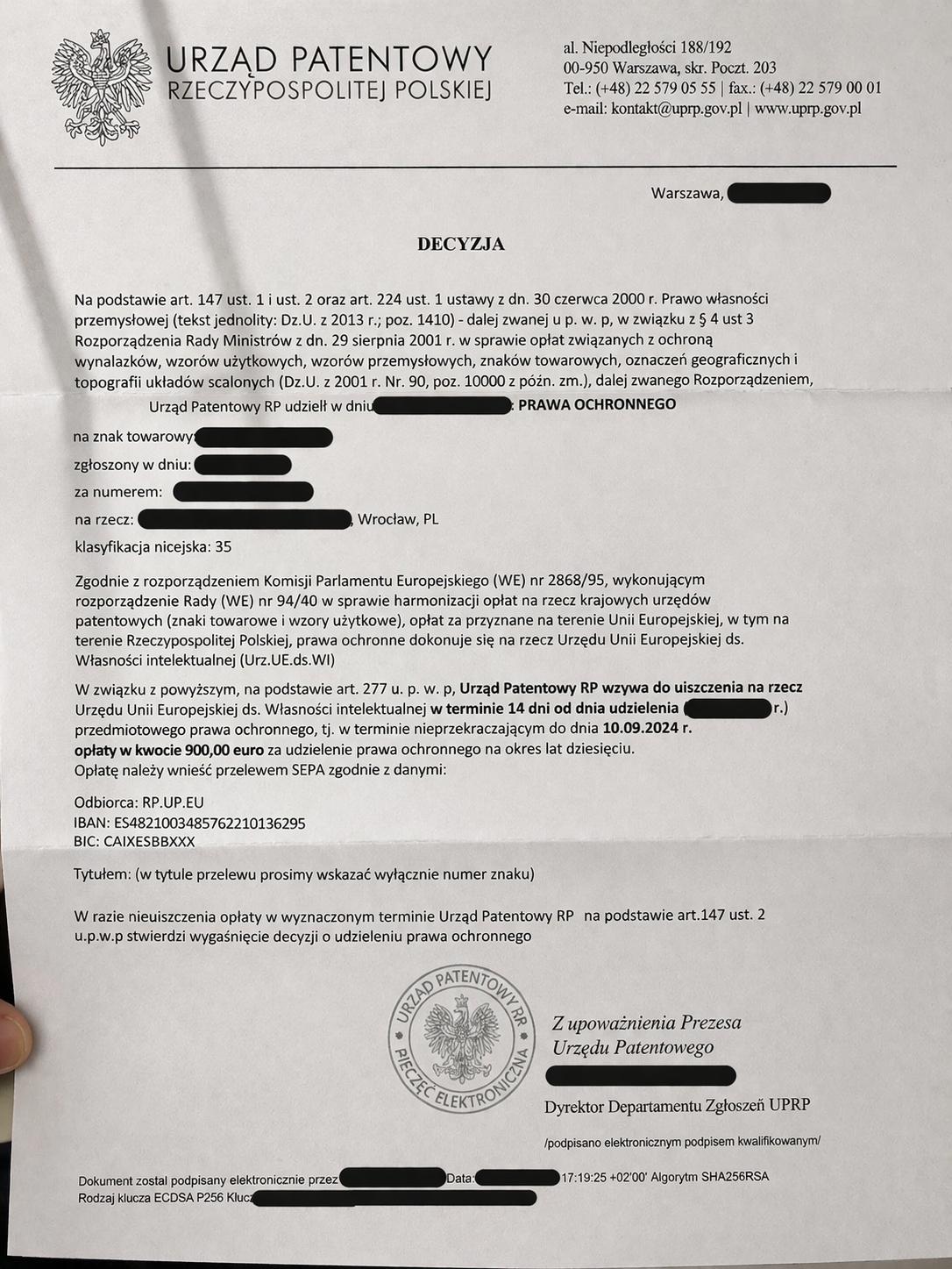
Document styled as a Polish Patent Office decision used in a trademark payment scam
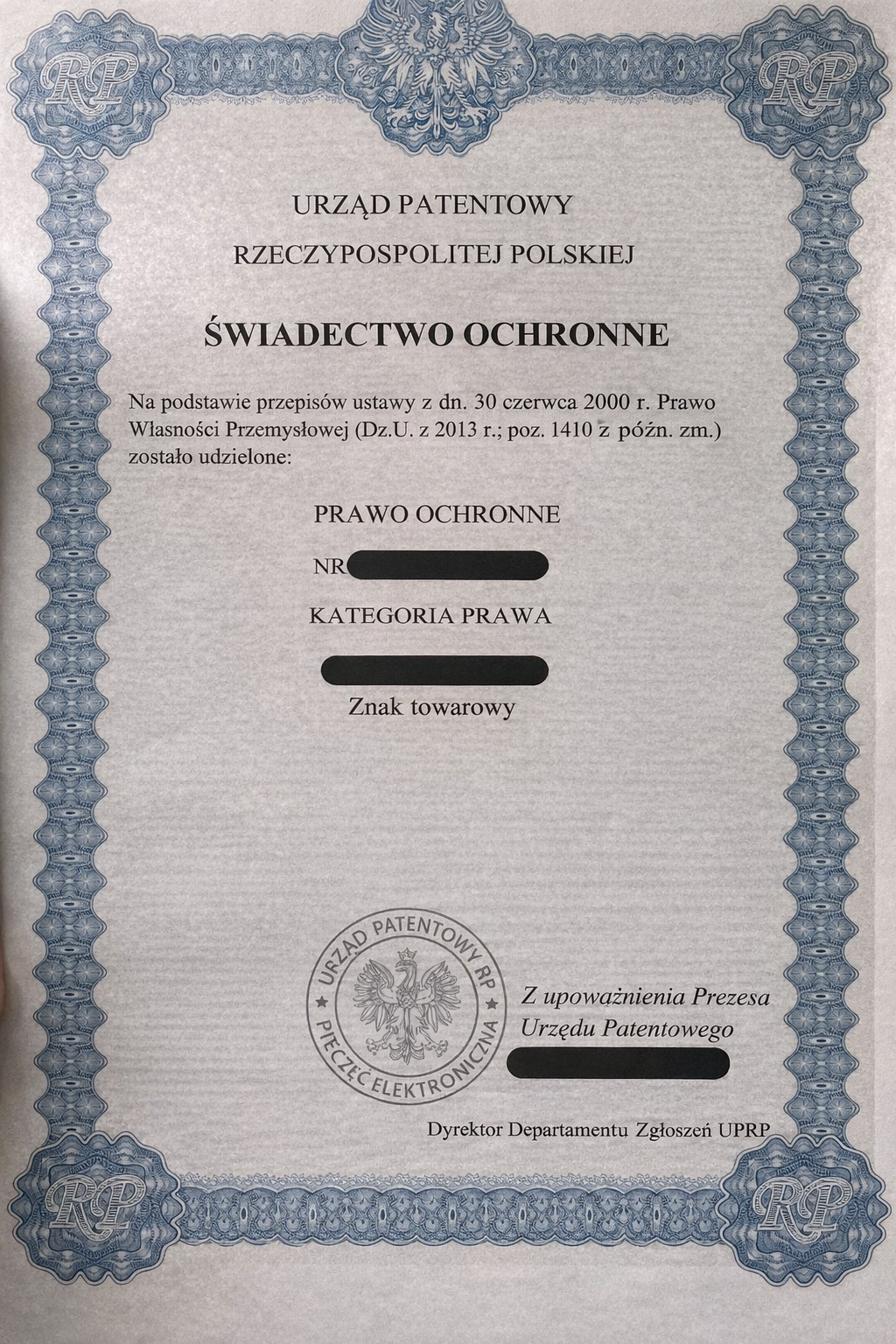
Fake Polish trademark protection certificate used in a payment scam
