
New Obligations for E-Commerce from 19 June 2026: How to Implement “Easy Withdrawal” (UX, Legal, IT)
Introduction: Why this matters beyond Poland and the EU
The Polish draft Act on Consumer Credit and amendments to consumer protection law (UC82) implements recent EU directives and introduces a fundamental shift in how consumer rights must be operationalized in e-commerce.
While this regulation formally applies within the European Union, its practical implications extend far beyond EU-based businesses.
Any e-commerce operator who:
sells to EU consumers, or
plans to expand into the EU market
will need to comply with these requirements.
This is not a minor regulatory update. It is a structural change affecting:
user experience (UX),
system architecture,
compliance models.
“Some provisions are expected to apply from 19 June 2026, including under Polish implementation. Although the legislative process is still ongoing, the regulatory direction is effectively settled, as it derives directly from EU law.
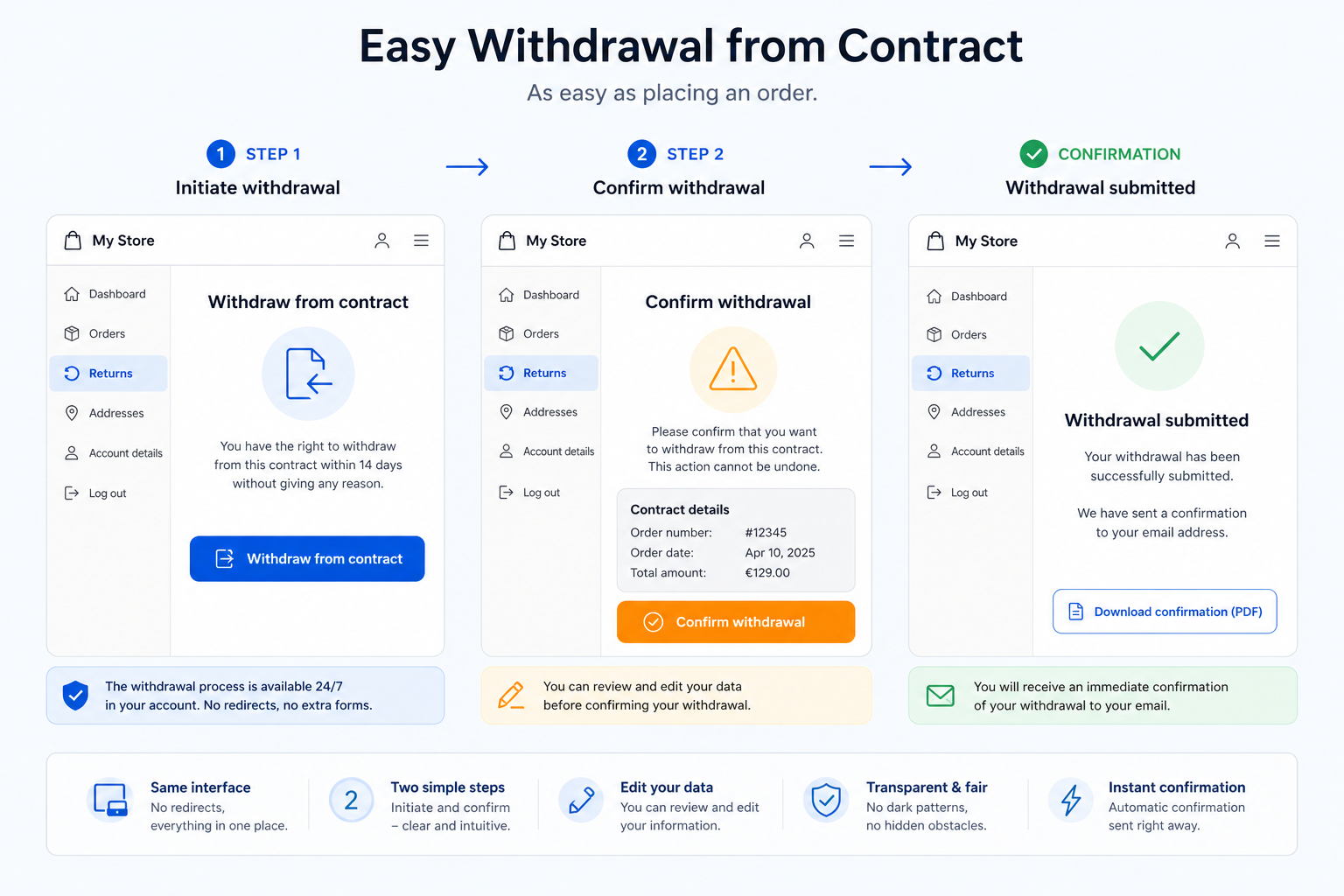
Modern e-commerce interface illustrating the “easy withdrawal from contract” process required by EU regulations. The design shows a two-step user flow with a visible “Withdraw from contract” button and a confirmation step, all completed within the same interface without redirects, ensuring clarity, accessibility and compliance.
What is actually changing?
The key shift introduced by the new regulations is this:
Compliance is no longer assessed only on documentation, it is assessed on how your system actually works.
Historically, businesses focused on:
terms and conditions,
withdrawal instructions,
formal disclosures.
Going forward, this will not be sufficient.
Authorities will look at:
how the interface behaves,
whether the process is intuitive,
whether the user can realistically exercise their right.
In other words:
UX becomes a legal matter, not just a product decision.
“Easy withdrawal”: what does it mean in practice?
The central requirement is simple in principle:
The consumer must be able to withdraw from a contract as easily as they can enter into it.
This translates into a mandatory digital withdrawal mechanism embedded directly in the user interface.
This is a major conceptual shift:
from a formal right
to a functional, accessible process
How should the withdrawal process work?
The law effectively defines a standardized UX pattern.
Every e-commerce platform must implement:
a two-step withdrawal process,
fully contained within the same interface (no redirects),
a clearly visible withdrawal button,
a separate confirmation step,
the ability for users to edit their data,
immediate confirmation of withdrawal on a durable medium (e.g. email, PDF).
Must the process stay within one interface?
Yes, 7485555584this is one of the strictest requirements.
The process:
must not redirect users to external pages,
must be completed within the same environment (e.g. user account, app).
This effectively prohibits:
external forms,
email-only withdrawal processes,
ticket-based workflows.
What does the two-step process look like?
Step 1 – Initiation
A clear and visible button, e.g.:
“Withdraw from contract”
Requirements:
easy to locate,
not hidden or obscured,
allows data editing if pre-filled.
Step 2 – Confirmation
A second action, e.g.:
“Confirm withdrawal”
Purpose:
ensure the decision is explicit and informed.
Both steps are mandatory, this is not optional UX.
Are redirects allowed?
No.
Redirects may be interpreted as:
obstructing consumer rights,
introducing friction into the process.
This is a critical issue for many existing systems.
UX as a legal requirement
The regulation directly impacts interface design.
Your system must ensure:
clarity,
accessibility,
absence of friction,
no manipulation,
user control over data.
This effectively introduces a legal standard for UX design.
Dark patterns: a key risk area
“Dark patterns” are interface designs that:
manipulate user behavior,
make certain actions harder to complete.
Examples include:
hidden buttons,
confusing navigation,
unnecessary steps discouraging action.
Many such patterns are embedded in:
SaaS platforms,
third-party templates,
non-EU design systems.
Using them, even unintentionally, may expose businesses to regulatory risk.
Who is affected?
The scope is broad.
These obligations apply to:
all businesses,
regardless of size,
across all industries.
There are no exemptions for SMEs.
For non-EU operators:
if you target EU consumers, you are in scope.
Timeline: when does this apply?
Key date: 19 June 2026
This should be treated as:
a compliance deadline, not a starting point.
While details may still evolve, the core obligations will remain.
Implementation challenges
Technology
In many cases, compliance will require more than frontend adjustments.
Legacy systems often:
lack flexibility,
rely on outdated workflows,
require backend changes for even simple UX updates.
The withdrawal process must integrate with:
order management systems,
returns handling,
communication systems,
data storage.
This frequently leads to full-stack implementation projects, not just UI changes.
Team competencies
This is not a single-team responsibility.
Effective implementation requires coordination between:
UX/UI designers,
product teams,
legal/compliance specialists,
developers.
A key challenge is redefining UX priorities:
from conversion-focused
to compliance-aware
Some previously accepted UX techniques may now be legally problematic.
Documentation and communication
Legal documentation must align with system behavior.
This includes:
terms and conditions,
withdrawal instructions,
user-facing messages.
Any mismatch between:
what the system does,
and what the documents say
may constitute non-compliance.
Common pitfalls
Based on current market practices, typical issues include:
no withdrawal function in the interface,
reliance on email or external forms,
inconsistent documentation,
use of non-compliant UI components,
lack of data editing options,
no automatic confirmation,
overly complex or unclear processes.
How to prepare your platform
Preparation should be treated as a structured project involving:
system design,
UX redesign,
legal alignment.
Minimum requirements include:
implementing the withdrawal function in the interface,
designing the two-step process,
enabling data control,
ensuring automatic confirmations,
updating documentation.
Recommended implementation approach
A pragmatic approach involves:
auditing the current process,
identifying compliance gaps,
implementing a compliant MVP,
iterating and optimizing over time.
This reduces risk and accelerates compliance.
Are SaaS platforms ready?
Not necessarily.
Key risks include:
limited customization options,
non-compliant default components,
restricted control over UX flows.
Operators should:
review platform capabilities,
assess vendor roadmaps,
consider custom extensions where needed.
Cost considerations
Costs vary depending on:
system architecture,
complexity,
scope of required changes.
Typical components include:
UX design,
development,
legal analysis.
Delaying implementation may increase costs due to:
time pressure,
limited developer availability.
Why you should not wait
Despite the 19th of June 2026 deadline:
system changes take time,
UX requires iteration,
integrations are complex.
Late implementation increases:
cost,
risk,
operational pressure.
Compliance audit: where to start
The first step is a structured audit.
Key questions:
Does the withdrawal function exist in the interface?
Does the process meet new requirements?
Is documentation aligned with actual behavior?
A proper audit helps define:
scope of changes,
risk exposure,
implementation priorities.
Conclusion
The Polish UC82 draft and related EU directives introduce:
new technological obligations,
increased responsibility for UX,
no exemptions for smaller businesses.
This is a system-level change requiring an integrated approach combining:
law, technology, and design.
Is your e-commerce ready?
If you are unsure:
whether your current process is compliant,
what changes are required,
how long implementation will take,
it is advisable to assess your situation now.
A structured compliance review today can prevent costly and high-risk changes later.
